I found out last week that there were over 100 applicants for the job I currently have. I had no idea. And I'm too dumbfounded to make any sense of the information.
I'd never imagined I could be competitive in the job market. Ever. I mean, I know I've had some opportunities that others haven't, but I don't necessarily connect those opportunities with being more competitive. Especially in my current job. I work with truly amazing people who inspire me; in no way am I on their level. I kind of thought I was hired because I was easy and convenient. It never crossed my mind that they might have actually wanted me. I'm just a crazy kid barely keeping her shit together-- how did I end up being selected out of over 100 people for a job that tons of people in my profession wish they could have?
I partially know the answer: one of my friends told me some of the applicants were over qualified. So that makes sense. And others were perhaps under qualified or not a good fit. *Maybe* that would narrow the applicant pool down to 50. I also know one of my friends put in a good word for me when I applied. I'm convinced that's what made the difference, though it's hard to believe I was chosen even with someone saying, "Hey, you should be sure to read my friend's application." His words must be very powerful.
And now I feel a bit of pressure, too. I mean more pressure. I want to do well. I always have. But now I also need to do well to prove I was a good choice out of those 50. To uphold whatever kind things my friend said to convince my boss to read my resume. To do justice to the other 49 or so people who really wanted to be here but aren't.
All of this makes me feel profoundly humbled. This past year I've been learning some hard lessons about not getting what I want, so I was genuinely shocked when my friend told me I should apply for this internship, which seemed to be (and is) pretty much exactly what I wanted. Nothing else had worked out, so why would this? I was even more shocked when el Jefe offered me the job. To think of the level of despair I was in before I knew about this job in comparison to now. . . . How could I have been chosen?
I've been going around so inwardly-focused and contrary I missed the opportunity to fully comprehend just how lucky I am to be here. I remember something I posted a few years ago when I was in Egypt when I was kind of in an opposite state: I was completely happy and fully aware of my fortunes. I'm so ashamed that here I am now, just as fortunate-- if not more fortunate-- and I haven't taken the time to fully appreciate my circumstances. I've been taking everything for granted. I'm ugly, spoiled. How could so many truly wonderful people have gone out of their way to help me? How can I ever repay you all? I don't even know where to begin.
Maybe I should begin by asking your forgiveness. You have all given me these opportunities, and I haven't been even remotely as appreciative as I ought to be. I'm sorry. Please forgive me. I promise to try to do better in the future. Because really, I am grateful to be here; and I'm constantly aware that I didn't get here alone. You have made all the difference in the world to me, and I thank you for that.
18 September 2011


05 September 2011
Images from the Coast
Some pictures to share from the Gulf Coast:
 |
| The path down the "canal" where I walk Biloxi |
 |
| More of the same path |
 |
| The "pond"-- it's even stocked with fish |
 |
| My first loaves of bread in my new home |
 |
| Dining room, pre-furniture |
 |
| Living room |
 |
| Kitchen |
 |
| Fireplace and entry (left) |
 |
| The bayou where I've been working on a restoration project |
 |
| Bayou restoration |
 |
| More bayou restoration |
 |
| A bridge at a nearby arboretum |
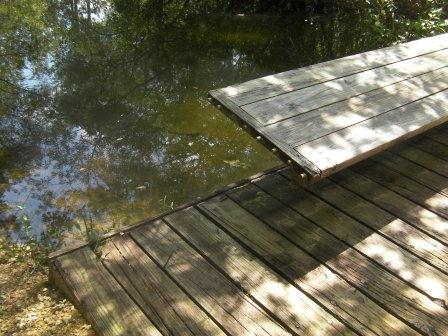 |
| Bridge detail |
 |
| After one of the heavy rains from Tropical Storm Lee |
 |
| The water rose over the inlet pipe (it's usually about halfway up the pipe) |
 |
| A family take a walk between downpours |
 |
| Loxi liked watching the storm from the balcony |
 |
| Here you can see how she has to sit funny because her body is long and her legs are short |
31 August 2011
We're Not Doctors
People are funny creatures. In some instances we're all too happy to pass responsibility to people we deem better able to manage our problems. We readily take medicine doctors prescribe us, rarely understanding how or why the medicine works; we allow engineers to determine the specifics of our sewer pipes and electrical lines, again rarely understanding the work that goes into our infrastructure; and we rely on lawyers to prosecute and defend us to keep everyone accountable to the law. We assign these people a certain power and are content to follow them (for the most part).
We do this because we recognize that some people have the knowledge it takes to solve certain problems while others don't. We value certain knowledge over others, and we evaluate who has that knowledge based on accreditations, certifications, degrees, and job positions. A doctor is only a doctor because he or she took many years to learn medicine and pass a slew of tests and training. Same thing for an engineer or a lawyer. Or an accountant. Or any other profession that requires licensing.
Any other profession, that is, except landscape architecture and perhaps architecture. In the professional fields of design, people spend years on education, training, and licensing to learn the best ways to shape the physical environment. Like medicine, design is complicated, intricate, and sometimes uncertain. There are very technical aspects of design and some more subjective aspects. It takes a certain skill to be able to successfully navigate the realm of design.
And yet, few communities or developers rely on landscape architects in the way people tend to rely on doctors, engineers, or lawyers. Even the best designers face community meetings stuffy with the residues of NIMBY attitudes. Even that's an accomplishment: it's enough of a challenge to be invited to the meeting to begin with.
So why is that? Are people overly optimistic about their abilities to address the same community planning challenges as a skilled, trained, and licensed professional? Is the profession overly simplified so that people have the perception that anyone can do it? Should landscape architecture even be a profession, considering so little value is placed on the practice?
Or maybe landscape architects should be more aggressive in the workplace? Maybe landscape architects should push for more power in the design and construction world? What if it were illegal to build a community without the assistance of a landscape architect? What if it were illegal to perform any construction at all without a landscape architect's approval?
It's not such a leap: medicine cannot be prescribed without a doctor's approval. That's for everyone's safety. I might argue the same could be said of landscape architecture. Who else is in a better position to understand the full implications of construction and community development? Who else is better qualified to weigh the economic, social, and environmental costs of building? In the past we haven't had anyone monitoring human expansion, and look where that's gotten us?
We do this because we recognize that some people have the knowledge it takes to solve certain problems while others don't. We value certain knowledge over others, and we evaluate who has that knowledge based on accreditations, certifications, degrees, and job positions. A doctor is only a doctor because he or she took many years to learn medicine and pass a slew of tests and training. Same thing for an engineer or a lawyer. Or an accountant. Or any other profession that requires licensing.
Any other profession, that is, except landscape architecture and perhaps architecture. In the professional fields of design, people spend years on education, training, and licensing to learn the best ways to shape the physical environment. Like medicine, design is complicated, intricate, and sometimes uncertain. There are very technical aspects of design and some more subjective aspects. It takes a certain skill to be able to successfully navigate the realm of design.
And yet, few communities or developers rely on landscape architects in the way people tend to rely on doctors, engineers, or lawyers. Even the best designers face community meetings stuffy with the residues of NIMBY attitudes. Even that's an accomplishment: it's enough of a challenge to be invited to the meeting to begin with.
So why is that? Are people overly optimistic about their abilities to address the same community planning challenges as a skilled, trained, and licensed professional? Is the profession overly simplified so that people have the perception that anyone can do it? Should landscape architecture even be a profession, considering so little value is placed on the practice?
Or maybe landscape architects should be more aggressive in the workplace? Maybe landscape architects should push for more power in the design and construction world? What if it were illegal to build a community without the assistance of a landscape architect? What if it were illegal to perform any construction at all without a landscape architect's approval?
It's not such a leap: medicine cannot be prescribed without a doctor's approval. That's for everyone's safety. I might argue the same could be said of landscape architecture. Who else is in a better position to understand the full implications of construction and community development? Who else is better qualified to weigh the economic, social, and environmental costs of building? In the past we haven't had anyone monitoring human expansion, and look where that's gotten us?
20 August 2011
Food!
Biloxi had a vet appointment today in Ocean Springs. She's healthy and much loved by all who met her. Since we were in the area, I decided to check out the Ocean Springs farmers' market-- many of my friends have been suggesting I go there. Well, the trip was a HUGE success.
First, I finally found local, free-range meat! There's a family farm about an hour inland that raises goats and sheep. Looks like meat's back on the menu, boys! The family also sells bones for dogs, goats milk products, and soaps. It's the best thing in the world to say I wash my hands with soap that comes from the same animals I eat, get dairy product from, and feed my dog with. It's even better when I add that the animals lived within a short drive of my house. I can barely contain my glee.
I also found a local creamery. I now have access to milk, cheeses, cream, sour cream, and cattle-based soap products. The milk isn't homogenized, so I can even use it to make cheeses of my own! Or I could make my own butter! It would be amazing if they sold ice cream, too, but the gentleman I spoke with said they don't have a way to transport it yet. Key word: yet.
So basically, I'm living it up down here on the Coast. My food is tasty, guilt-free, and better for the planet. Come visit me and I'll treat you to the best local flavors the Gulf has to offer. :)
First, I finally found local, free-range meat! There's a family farm about an hour inland that raises goats and sheep. Looks like meat's back on the menu, boys! The family also sells bones for dogs, goats milk products, and soaps. It's the best thing in the world to say I wash my hands with soap that comes from the same animals I eat, get dairy product from, and feed my dog with. It's even better when I add that the animals lived within a short drive of my house. I can barely contain my glee.
I also found a local creamery. I now have access to milk, cheeses, cream, sour cream, and cattle-based soap products. The milk isn't homogenized, so I can even use it to make cheeses of my own! Or I could make my own butter! It would be amazing if they sold ice cream, too, but the gentleman I spoke with said they don't have a way to transport it yet. Key word: yet.
So basically, I'm living it up down here on the Coast. My food is tasty, guilt-free, and better for the planet. Come visit me and I'll treat you to the best local flavors the Gulf has to offer. :)
11 August 2011
Today's Musings
My absolute favorite thing to do is to be in a room with people who think about the world differently than I do. It affords me the occasion to evaluate what I think about various topics and exposes me to perspectives I haven't had the chance to entertain before.
For example, as part of my internship people from my studio gather once a week to discuss a reading or a presentation or some such thing. Tonight we read about leadership. The author makes a distinction between leadership with authority (such as that of the President Johnson) and leadership without authority (such as that of Martin Luther King, Jr.). The author describes the importance and nuances of each type of leadership with examples from the Civil Rights movement. Our group discussion about these readings has left some lingering thoughts, some of them more relevant than others.
I learned some things about the Civil Rights movement today. Namely, the various layers of strategy employed by both Civil Rights activists and opponents impressed me. I'd been unaware of many of the nuances of the movement. For example, I was unaware that part of Dr. King's ideas of peaceful protest involved the hope that the opponents would react violently, thus giving his cause much-needed media attention. Which brings me to my first musing: it bothers me that a type of protest that measures its success on whether or not the opponent reacts violently is called "peaceful." Likewise, it bothers me that the intention of the Civil Rights marches were to provoke a violent response that would be captured on television. I'm not saying all marches and sit-ins were like that, but the ones documented in our reading apparently fit that description. So I voiced my surprise about the indirect use of violence to achieve a political end. The group's response was that the indirect use of violence was different than the direct use of violence, and perhaps could even be considered "good." There was little agreement with my observation that the indirect use of violence was shameful. In my mind, there's an important difference between staging a protest with the intention of provoking a fight and staging one that intends to remain peaceful. The author leaves little doubt about the intentions of the protestors in his example: after describing a horrific scene of police brutality and murder the author states, "At once.... King and the demonstrators had won" (Pg. 216).
Now, there are many counter-arguments to my thoughts on this topic. For example, one could point out that the demonstrators were attacking the violence more than anything. It was as if they were saying to the rest of the world, "See? This is what they do on national television--imagine what they do when the cameras aren't around. You are witnessing what our people have been putting up with for more than a century. Are you going to continue to allow this to happen in our country?" In that sense, the demonstrators were less provoking their opponents than they were exposing their opponents (though the author uses the word "provoke"). And maybe that's why their "peaceful" protests were ultimately so successful.
Another point against my assessment could be that intentions don't amount to a hill of beans-- regardless of what the protestors wanted to occur, they did not initiate any violence nor respond to the violence with violence. Their actions were peaceful, and ultimately actions are what define a person or movement. We can only speculate on others' intentions.
Which brings me to the bulk of my musings and a question I've puzzled over consciously since my freshman year at college: Are actions more important than intentions? "They" say the road to hell is paved with good intentions, which I suppose perpetuates the idea that intentions aside, your actions are what matters in the end. And while I can absolutely see the merit with that thought, I also have trouble dismissing a person's intentions completely. For example, suppose one woman accidentally gets pregnant and insists that the unwilling father help raise the child while another woman "accidentally" (read: "intentionally and against the man's desires") gets pregnant and insists that the unwilling father help raise the child. While both situations are tragic in their own ways, certainly there's slightly less sympathy or acceptance for the second woman. But again, how do you prove another person's intentions?
As another and significantly less controversial example, I have some friends who were raised in deeply religious families. Some of those friends have since decided to part with the church, much to their families' dismay. In some instances, the families' actions are to proselytize all the more vigorously in hopes of "saving" their beloved family member from eternal damnation, often belittling or insulting the beloved family member in the process; however, their intentions are positive-- they want to share the security and joy they feel in their faith with someone they love. Does that make up for the insults or belittling? No. But in my opinion it does help to take out the sting.
Long story short, I haven't made much progress on answering my question. There are numerous examples in my life where the only reason I've been able to forgive someone for something they did to me was because I could take comfort in "knowing" that person didn't intend to hurt me (again, can we ever really know?). I'm sure I've hurt people in my life without intending to, and I hope they forgive me even though my actions did, in fact, hurt them. After all, we all tend to be self-centered, and that makes it difficult for us to see how our actions affect people around us. If I can ask for forgiveness on the basis of "I didn't mean to hurt you," then surely I can give forgiveness on similar grounds?
Conversely, since it's difficult to assign legitimacy to what people "meant" to do, maybe it is wise to discount it. Maybe it's better to examine only people's actions. Someone close to me hurt me very deeply; he didn't mean to, but he did. And because he did, I can be angry at him. I don't have a reason to forgive him because he's no longer in my life, so why would I? It takes much less effort to simply hold a grudge.
In some ways I can get behind that line of thinking, but personally, I doubt I'd ever forgive anyone because the act of forgiving would be so exhausting. It's exhausting because I don't have the strength to "forgive and forget" without a reason. I imagine I'm in good company on that point. Most of us forgive because it's too inconvenient not to, not because of any virtue of our own-- if you fight with a sibling, it's typically (though not always) much easier to forgive her because you'll have to continue spending at least some time with her for the rest of your life. And I'll bet none of us forgets an offense regardless of whether or not it's been forgiven (which then begs the question, did you really forgive?).
Some people have a talent for forgiveness, which I imagine takes great strength. I also imagine people with that talent either see the world from a "well, she didn't mean to hurt me" perspective or else they think holding a grudge is too exhausting and have found a way to achieve forgiveness simply to relieve some of the burden of holding a grudge (as opposed to finding forgiveness too exhausting). The first way of forgiving I find much easier; the second way I find nearly impossible, though I've read about people who seem to do it on a daily basis.
Point being (as I ramble along), I haven't gotten anywhere on this question. It seems my mind takes me in circles.
For example, as part of my internship people from my studio gather once a week to discuss a reading or a presentation or some such thing. Tonight we read about leadership. The author makes a distinction between leadership with authority (such as that of the President Johnson) and leadership without authority (such as that of Martin Luther King, Jr.). The author describes the importance and nuances of each type of leadership with examples from the Civil Rights movement. Our group discussion about these readings has left some lingering thoughts, some of them more relevant than others.
I learned some things about the Civil Rights movement today. Namely, the various layers of strategy employed by both Civil Rights activists and opponents impressed me. I'd been unaware of many of the nuances of the movement. For example, I was unaware that part of Dr. King's ideas of peaceful protest involved the hope that the opponents would react violently, thus giving his cause much-needed media attention. Which brings me to my first musing: it bothers me that a type of protest that measures its success on whether or not the opponent reacts violently is called "peaceful." Likewise, it bothers me that the intention of the Civil Rights marches were to provoke a violent response that would be captured on television. I'm not saying all marches and sit-ins were like that, but the ones documented in our reading apparently fit that description. So I voiced my surprise about the indirect use of violence to achieve a political end. The group's response was that the indirect use of violence was different than the direct use of violence, and perhaps could even be considered "good." There was little agreement with my observation that the indirect use of violence was shameful. In my mind, there's an important difference between staging a protest with the intention of provoking a fight and staging one that intends to remain peaceful. The author leaves little doubt about the intentions of the protestors in his example: after describing a horrific scene of police brutality and murder the author states, "At once.... King and the demonstrators had won" (Pg. 216).
Now, there are many counter-arguments to my thoughts on this topic. For example, one could point out that the demonstrators were attacking the violence more than anything. It was as if they were saying to the rest of the world, "See? This is what they do on national television--imagine what they do when the cameras aren't around. You are witnessing what our people have been putting up with for more than a century. Are you going to continue to allow this to happen in our country?" In that sense, the demonstrators were less provoking their opponents than they were exposing their opponents (though the author uses the word "provoke"). And maybe that's why their "peaceful" protests were ultimately so successful.
Another point against my assessment could be that intentions don't amount to a hill of beans-- regardless of what the protestors wanted to occur, they did not initiate any violence nor respond to the violence with violence. Their actions were peaceful, and ultimately actions are what define a person or movement. We can only speculate on others' intentions.
Which brings me to the bulk of my musings and a question I've puzzled over consciously since my freshman year at college: Are actions more important than intentions? "They" say the road to hell is paved with good intentions, which I suppose perpetuates the idea that intentions aside, your actions are what matters in the end. And while I can absolutely see the merit with that thought, I also have trouble dismissing a person's intentions completely. For example, suppose one woman accidentally gets pregnant and insists that the unwilling father help raise the child while another woman "accidentally" (read: "intentionally and against the man's desires") gets pregnant and insists that the unwilling father help raise the child. While both situations are tragic in their own ways, certainly there's slightly less sympathy or acceptance for the second woman. But again, how do you prove another person's intentions?
As another and significantly less controversial example, I have some friends who were raised in deeply religious families. Some of those friends have since decided to part with the church, much to their families' dismay. In some instances, the families' actions are to proselytize all the more vigorously in hopes of "saving" their beloved family member from eternal damnation, often belittling or insulting the beloved family member in the process; however, their intentions are positive-- they want to share the security and joy they feel in their faith with someone they love. Does that make up for the insults or belittling? No. But in my opinion it does help to take out the sting.
Long story short, I haven't made much progress on answering my question. There are numerous examples in my life where the only reason I've been able to forgive someone for something they did to me was because I could take comfort in "knowing" that person didn't intend to hurt me (again, can we ever really know?). I'm sure I've hurt people in my life without intending to, and I hope they forgive me even though my actions did, in fact, hurt them. After all, we all tend to be self-centered, and that makes it difficult for us to see how our actions affect people around us. If I can ask for forgiveness on the basis of "I didn't mean to hurt you," then surely I can give forgiveness on similar grounds?
Conversely, since it's difficult to assign legitimacy to what people "meant" to do, maybe it is wise to discount it. Maybe it's better to examine only people's actions. Someone close to me hurt me very deeply; he didn't mean to, but he did. And because he did, I can be angry at him. I don't have a reason to forgive him because he's no longer in my life, so why would I? It takes much less effort to simply hold a grudge.
In some ways I can get behind that line of thinking, but personally, I doubt I'd ever forgive anyone because the act of forgiving would be so exhausting. It's exhausting because I don't have the strength to "forgive and forget" without a reason. I imagine I'm in good company on that point. Most of us forgive because it's too inconvenient not to, not because of any virtue of our own-- if you fight with a sibling, it's typically (though not always) much easier to forgive her because you'll have to continue spending at least some time with her for the rest of your life. And I'll bet none of us forgets an offense regardless of whether or not it's been forgiven (which then begs the question, did you really forgive?).
Some people have a talent for forgiveness, which I imagine takes great strength. I also imagine people with that talent either see the world from a "well, she didn't mean to hurt me" perspective or else they think holding a grudge is too exhausting and have found a way to achieve forgiveness simply to relieve some of the burden of holding a grudge (as opposed to finding forgiveness too exhausting). The first way of forgiving I find much easier; the second way I find nearly impossible, though I've read about people who seem to do it on a daily basis.
Point being (as I ramble along), I haven't gotten anywhere on this question. It seems my mind takes me in circles.
07 August 2011
Miss Loxi Biloxi
I ADOPTED A PUPPY!!!!
Really, I did. And she's about as cute as a bow-legged little mutt can be. And I mean that with all the love a new petowner can possibly have. I mean, just look at her:


She's just over 8 months old, so a lot of the destructive puppy phase is out of her, which suits me just fine. She's been an angel. I think I'm going to call her Miss Biloxi, or "Loxi" for short. I'll be adding much more detail about our adventures together, so be looking forward to it!
Really, I did. And she's about as cute as a bow-legged little mutt can be. And I mean that with all the love a new petowner can possibly have. I mean, just look at her:


She's just over 8 months old, so a lot of the destructive puppy phase is out of her, which suits me just fine. She's been an angel. I think I'm going to call her Miss Biloxi, or "Loxi" for short. I'll be adding much more detail about our adventures together, so be looking forward to it!
30 July 2011
Payday!
I've finished two weeks a the GCCDS, which means I've received my first paycheck. Go me! I'm earning money now! Too bad most of it's going to pay bills.....
The past two weeks have gone by quickly, but there have been a few distinct moments from Day One to Paycheck. My first day was a rush: I spent the morning with my new boss, let's call him "el Jefe," and various smaller groups of my co-workers talking about the various projects I'll be working on. After that, el Jefe left on a two-week vacation, and I haven't seen him since that first day. Kind of strange to start a job without a boss, but it's been nice in terms of getting used to the place without the added pressure of a direct supervisor.
I spent that first afternoon working on a site plan for our Bayou Auguste project. That's the project that's been taking up the majority of my time. The first few days I was doing digital design work, so after a while the thought crossed my mind, "Wait a second, I'm doing exactly what I was doing in college, and I didn't really like doing it then. Shit. How did that happen?" And to Ball State's credit, it really was just like college, or maybe college was just like work? We work in a studio much like the ones at CAP, everyone works on their own projects, and we frequently assemble to discuss our progress. It turns out my education did prepare me for the workplace. Who knew? Anyway, the more I thought about the similarities the more uncomfortable I got. And then I had a wonderful realization: No! This is exactly different from college! I'm getting paid to be here! Not the other way around!
After that my perception of working in the "real world" dramatically shifted. And the next day so did the nature of my work. It turns out I've spent around half of my working time outside or at least out of the office the past two weeks. And I think that's how it's going to be.
Remember the bayou project I mentioned? Well, we don't have a contractor building the structures, which means I get to be onsite doing construction. I'm thrilled. I've been building gabions, hauling crushed concrete, and digging trenches for a wall structure we're putting in. For the most part it's been me and two others doing the work, though this past week we had several volunteers come to help. I couldn't be happier with this aspect of my job. Seriously, it's great.
And I have to mention another great aspect of my job: the registered landscape architect, who will be called Ustaadh. Ustaadh is a great teacher-- he's brought me to all of his project sites and he's started teaching me Mississippi's plant palette. He even requested a detour on the way back from a meeting in New Orleans to take the interns and me to an arboretum. When he introduces me to clients or partners, he refers to me as the studio's new landscape architect, which is technically not true. You see, until I'm licensed I can't legally call myself a landscape architect; however, it can be a bit tricky to eloquently explain to people what it is that I do without using the words "landscape architect," though I do my best. Some RLAs get really protective of their title, and while I can't blame them, I really appreciate that Ustaadh isn't like that. It makes being around him and learning from him very relaxing.
The past two weeks have gone by quickly, but there have been a few distinct moments from Day One to Paycheck. My first day was a rush: I spent the morning with my new boss, let's call him "el Jefe," and various smaller groups of my co-workers talking about the various projects I'll be working on. After that, el Jefe left on a two-week vacation, and I haven't seen him since that first day. Kind of strange to start a job without a boss, but it's been nice in terms of getting used to the place without the added pressure of a direct supervisor.
I spent that first afternoon working on a site plan for our Bayou Auguste project. That's the project that's been taking up the majority of my time. The first few days I was doing digital design work, so after a while the thought crossed my mind, "Wait a second, I'm doing exactly what I was doing in college, and I didn't really like doing it then. Shit. How did that happen?" And to Ball State's credit, it really was just like college, or maybe college was just like work? We work in a studio much like the ones at CAP, everyone works on their own projects, and we frequently assemble to discuss our progress. It turns out my education did prepare me for the workplace. Who knew? Anyway, the more I thought about the similarities the more uncomfortable I got. And then I had a wonderful realization: No! This is exactly different from college! I'm getting paid to be here! Not the other way around!
After that my perception of working in the "real world" dramatically shifted. And the next day so did the nature of my work. It turns out I've spent around half of my working time outside or at least out of the office the past two weeks. And I think that's how it's going to be.
Remember the bayou project I mentioned? Well, we don't have a contractor building the structures, which means I get to be onsite doing construction. I'm thrilled. I've been building gabions, hauling crushed concrete, and digging trenches for a wall structure we're putting in. For the most part it's been me and two others doing the work, though this past week we had several volunteers come to help. I couldn't be happier with this aspect of my job. Seriously, it's great.
And I have to mention another great aspect of my job: the registered landscape architect, who will be called Ustaadh. Ustaadh is a great teacher-- he's brought me to all of his project sites and he's started teaching me Mississippi's plant palette. He even requested a detour on the way back from a meeting in New Orleans to take the interns and me to an arboretum. When he introduces me to clients or partners, he refers to me as the studio's new landscape architect, which is technically not true. You see, until I'm licensed I can't legally call myself a landscape architect; however, it can be a bit tricky to eloquently explain to people what it is that I do without using the words "landscape architect," though I do my best. Some RLAs get really protective of their title, and while I can't blame them, I really appreciate that Ustaadh isn't like that. It makes being around him and learning from him very relaxing.
Subscribe to:
Posts (Atom)